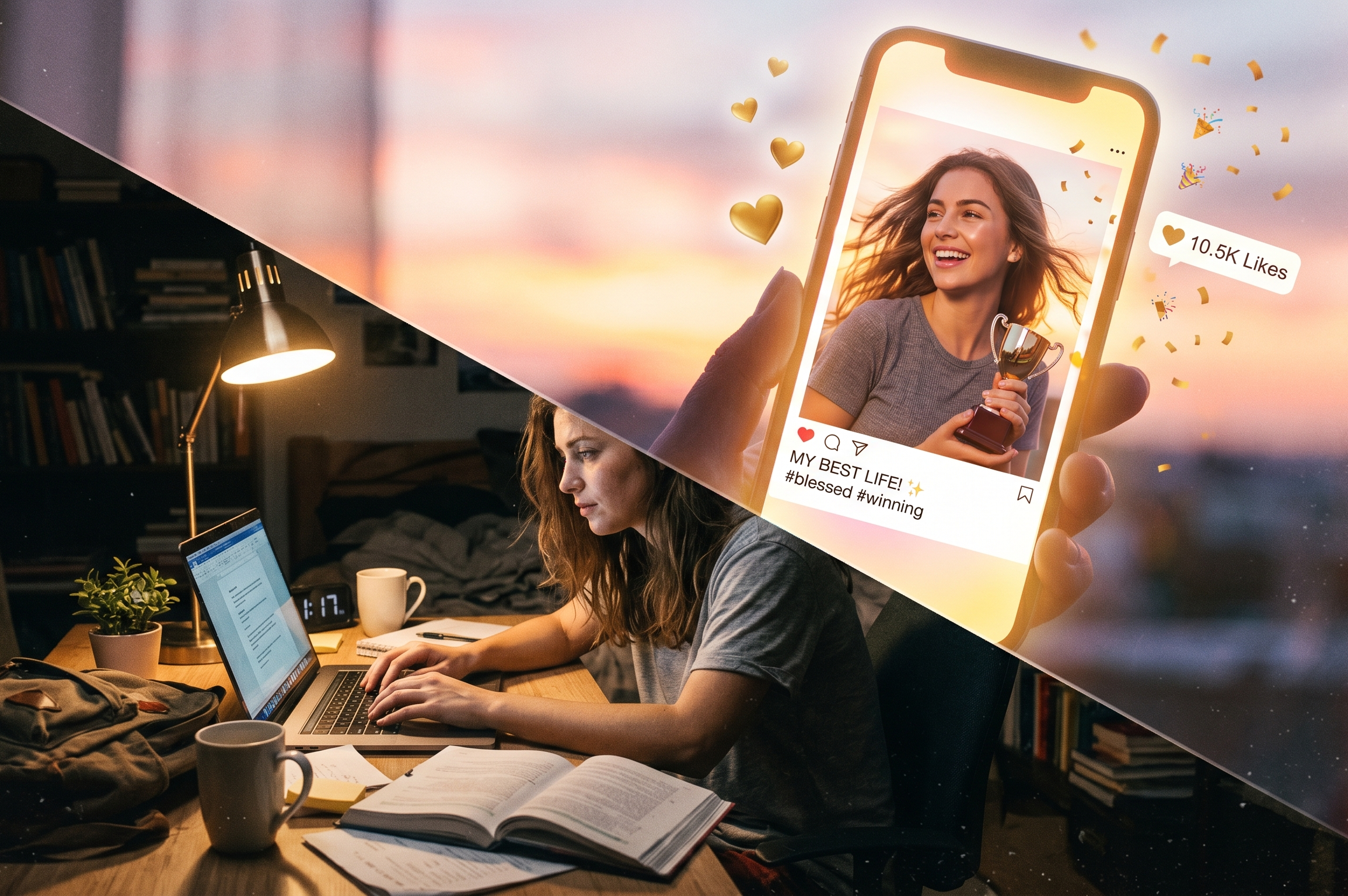
Social media empowers the marginalized and bridges global distances with a single click. Yet, beneath this connectivity lies a shadow of comparison that threatens our mental well-being.
By Rayees Ahmad Kumar
Social media is no longer just a digital accessory; it is the fundamental architecture of modern life. As we cross into 2026, the statistics are staggering: approximately 5.66 billion people nearly 70% of the global population are now active on at least one social platform. What began as a tool for connection has evolved into a complex ecosystem that shapes our economies, our politics, and our very identities.
However, as this digital reality deepens, so does the “temptation”, a sophisticated pull that threatens to replace authentic living with a curated, algorithmic shadow.
The benefits of social media are undeniable and rooted in reality. It has democratized information, allowing a student in a rural village to access the same educational resources as one in a major metropolis. In 2026, platforms like YouTube and Reddit have become primary research hubs, with nearly 20% of users utilizing Reddit specifically for high-intent information gathering.
For businesses, the landscape has shifted entirely. Social media advertising is projected to exceed $317 billion this year, providing growth opportunities for small entrepreneurs and global giants alike. Beyond commerce, it remains a lifeline for the marginalized. From amplifying human rights movements to providing instant news in conflict zones, social media has proven that an ordinary voice can indeed shake the world.
Yet, every light has a shadow. The “reality” we see on our screens is frequently a curated fiction. Psychologists point to the “Highlight Reel” effect: the tendency for users to post only their most successful, beautiful, and happy moments.
This creates a distorted baseline for reality. When a person scrolls through a feed of filtered vacations and career milestones, the brain naturally engages in upward social comparison. Research from JAMA Psychiatry in late 2025 confirmed that users spending more than three hours daily on these platforms report significantly higher rates of anxiety and depression. We are measuring our “behind-the-scenes” struggles against everyone else’s “best-of” clips, leading to a profound sense of inferiority and the erosion of inner peace.
The most dangerous evolution of social media is its shift from a communication tool to an “Attention Economy.” Platforms are not neutral; they are engineered for addiction. Using a psychological tactic known as variable ratio reinforcement, the same mechanism that makes slot machines addictive, features like “infinite scroll” and “autoplay” keep users engaged for as long as possible.
“We have accepted the unrestricted mining of human consciousness. We are the resource, and it takes its toll.” Tim Wu, Author of The Attention Merchants.
In 2026, the line between reality and temptation is further blurred by Generative AI. The emergence of deepfakes and AI-generated content means that what we see and hear can no longer be taken at face value.
This “Synthetic Reality” tests our integrity. From a moral and religious perspective, the temptation toward “showmanship” has never been higher. Sincerity, the act of doing good for its own sake is often sacrificed for the digital “display.” We risk becoming a society that values the appearance of virtue over the practice of it.
Social media is ultimately a tool, and like any tool, its value is determined by the hand that holds it. We are currently at a turning point. Recent legal verdicts, such as the March 2026 negligence ruling against Meta and Google in Los Angeles, suggest that society is finally demanding more accountability and “digital guardrails.”
However, systemic change is only half the battle. The other half is personal. To navigate this landscape, we must adopt a strategy of Digital Intentionality:
- Audit Your Feed: Unfollow accounts that trigger comparison or inadequacy.
- Set Boundaries: Establish “phone-free” hours, particularly during meals and before sleep.
- Value Sincerity over Likes: Reclaim the parts of your life that don’t need to be shared to be meaningful.
Social media is a mirror that reflects our collective human nature, both our desire for connection and our susceptibility to vanity. As we look toward the future, we must remember that while the digital world is expansive, it is also temporary. Our likes, followers, and curated posts will not endure; only the truth of how we lived and the sincerity of our actions will remain.
The question remains for every user: Are you using social media to enhance your reality, or is social media using you to feed its temptation? The choice, as always, is yours.
The views expressed in this article are solely those of the author and do not necessarily reflect the opinions or views of this newspaper
Leave a Reply