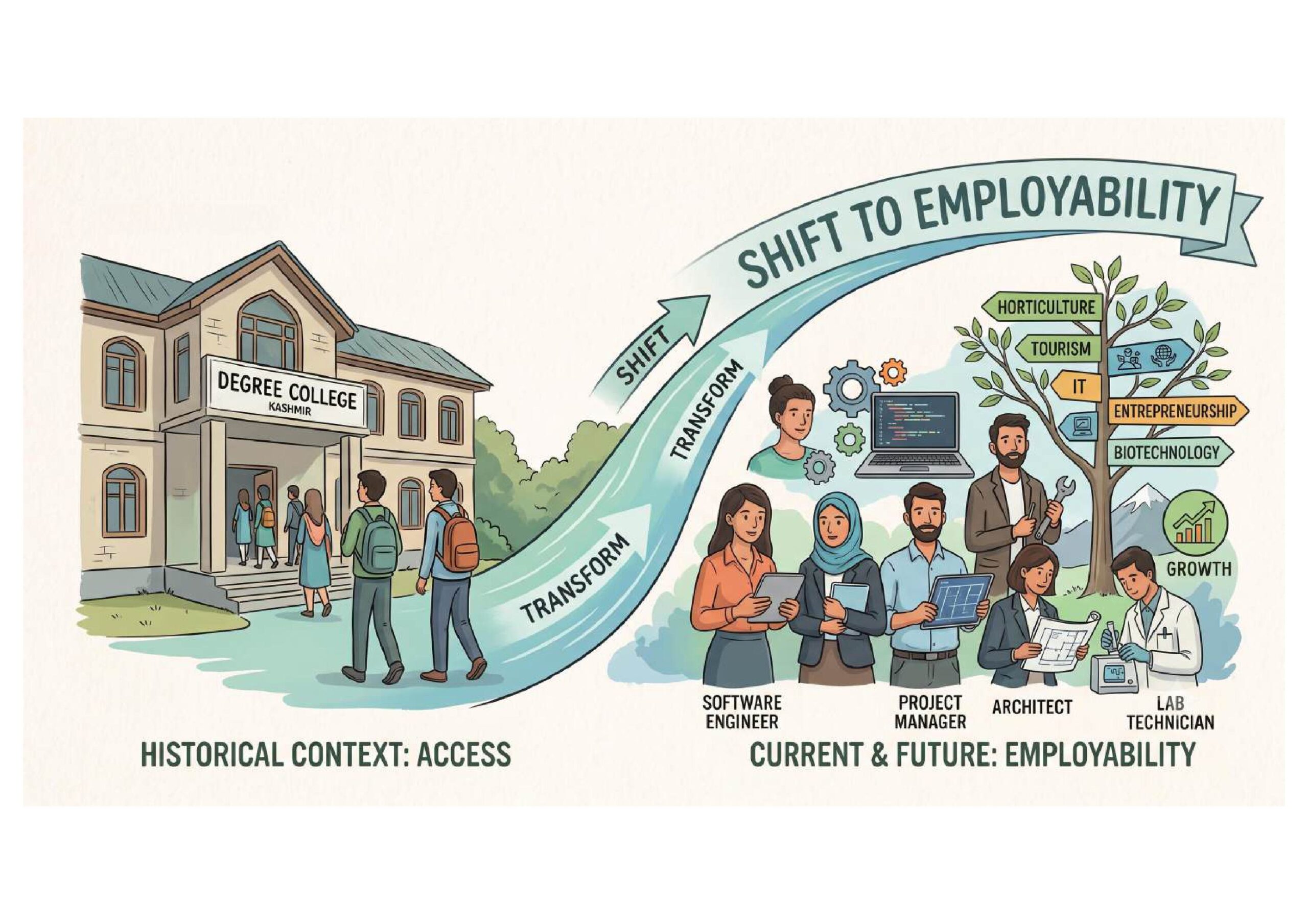
Why Kashmir’s Higher Education Needs a Shift from Access to Employability
By Mir Tanveer
For decades, Jammu and Kashmir has invested heavily in democratizing access to higher education. The establishment of Government Degree Colleges (GDCs) across nearly every tehsil and sub-district brought classrooms closer to home than ever before. This expansion deservedly earned praise for breaking down steep geographical and socioeconomic barriers, enabling tens of thousands of young men and women, particularly in rural belts to enter tertiary education.
Yet, as the physical infrastructure reached its peak, a far more challenging crisis took root. The defining question facing Jammu and Kashmir today is no longer whether degree colleges exist, but whether they retain any functional relevance to student aspirations and the demands of a modern labour market. Recent official data presented before the Jammu and Kashmir Legislative Assembly has exposed a stark reality: student enrolment is plummeting across dozens of GDCs, with several peripheral institutions registering single-digit admissions and some operating with virtually zero students. When prospective students bypass local campuses, it signals a fundamental erosion of trust: physical expansion without qualitative value can no longer sustain public confidence in higher education.
This institutional crisis demands that the public debate move decisively beyond bricks and mortar. Modern academic blocks, smart classrooms, and well-equipped laboratories are necessary foundations, but infrastructure alone cannot define an institution’s success. A university or college must ultimately be judged by the caliber of graduates it nurtures and the economic pathways it creates. If young people exit three- or four-year degree programmes without acquiring practical, market-aligned skills, educational expansion remains an empty statistic.
At the heart of this problem lies a deep, unaddressed disconnect between academic curricula and industry realities. For decades, degree programmes have remained locked in traditional classroom lecturing, leaving students to spend years absorbing abstract theories. Most graduate without ever completing an industry internship, participating in field research, acquiring digital competencies, or engaging with professional mentors. When these graduates step into the hiring market, employers routinely reject them for lacking basic entry-level competencies. Bridging this structural divide must become the paramount policy objective of the Higher Education Department.
Colleges must evolve from isolated degree-granting centers into active ecosystem hubs. Higher education institutions must form structural partnerships with regional industries, healthcare networks, research institutes, government agencies, media organizations, local startups, and agricultural enterprises. Applied skill-based certifications, hands-on field projects, entrepreneurship incubators, and structured apprenticeships must be woven into the mandatory core of degree frameworks rather than treated as optional extra-curricular activities.
In a Union Territory where youth unemployment remains a critical challenge, continuing to condition students for an exceptionally narrow spectrum of job opportunities is economically unsustainable. For generations, a university degree in Kashmir was viewed almost exclusively as a pathway to public sector employment. While government jobs retain social prestige, the public sector lacks the capacity to absorb the volume of educated youth entering the workforce each year.
Kashmir urgently requires a forward-looking Career Expansion Strategy that diversifies opportunity structures. The region holds untapped potential across high-growth sectors, including advanced horticulture, eco-tourism, environmental management, disaster management, renewable energy, biotechnology, information technology, healthcare services, digital media, and supply chain logistics. Higher education must purposefully equip students with the technical and managerial tools needed to build careers and launch enterprises within these emerging domains.

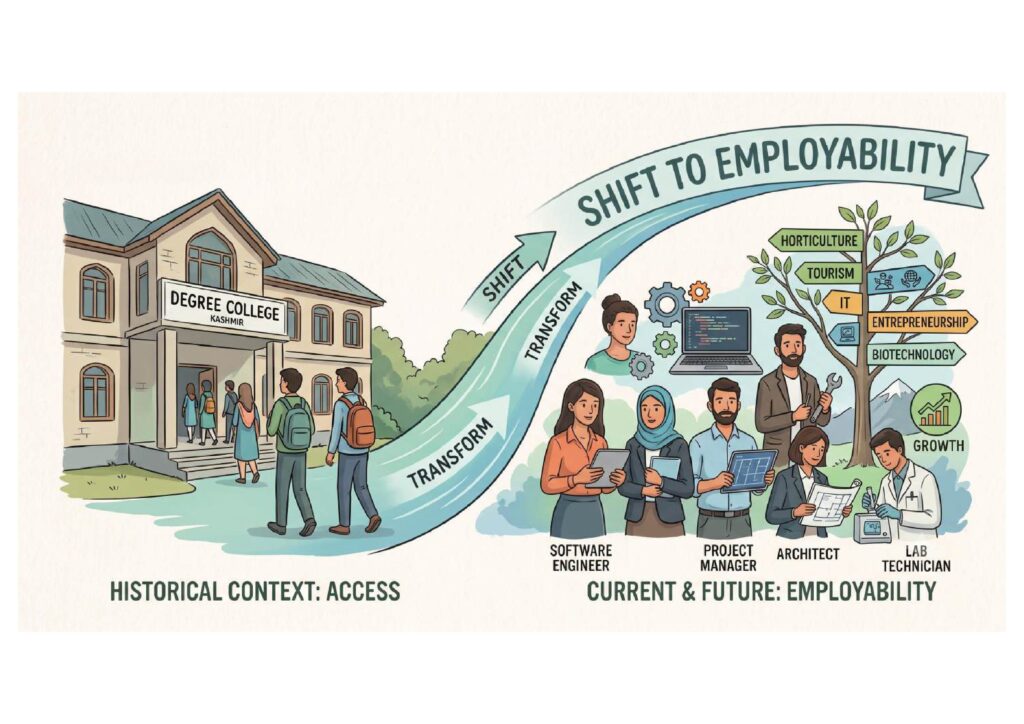
Crucially, this shift does not call for discarding foundational disciplines. Core subjects like Botany, Chemistry, Environmental Science, Economics, Sociology, Political Science, and History retain immense value. The imperative is to overhaul how these subjects are taught infusing them with data literacy, research methodologies, policy analysis, creative innovation, and real-world problem-solving.
The National Education Policy (NEP) 2020 and the Four-Year Undergraduate Programme (FYUP) framework provide the policy blueprint for this transition through multidisciplinary choices, flexible credit transfers, and research tracks. However, policy on paper must translate into practice inside the classroom.
Literacy and formal qualifications alone cannot guarantee sustainable livelihoods. Education must build tangible employability, adaptability, and an entrepreneurial mindset. The true benchmark of Kashmir’s higher education system should not be measured by the count of new college buildings constructed, but by the number of viable careers built, enterprises sparked, and livelihoods secured. Only then will higher education institutions become genuine engines of social prosperity and economic transformation.
Disclaimer: The views expressed in this feature article are solely those of the author and do not necessarily reflect the official editorial stance or opinions of this publication.
Leave a Reply