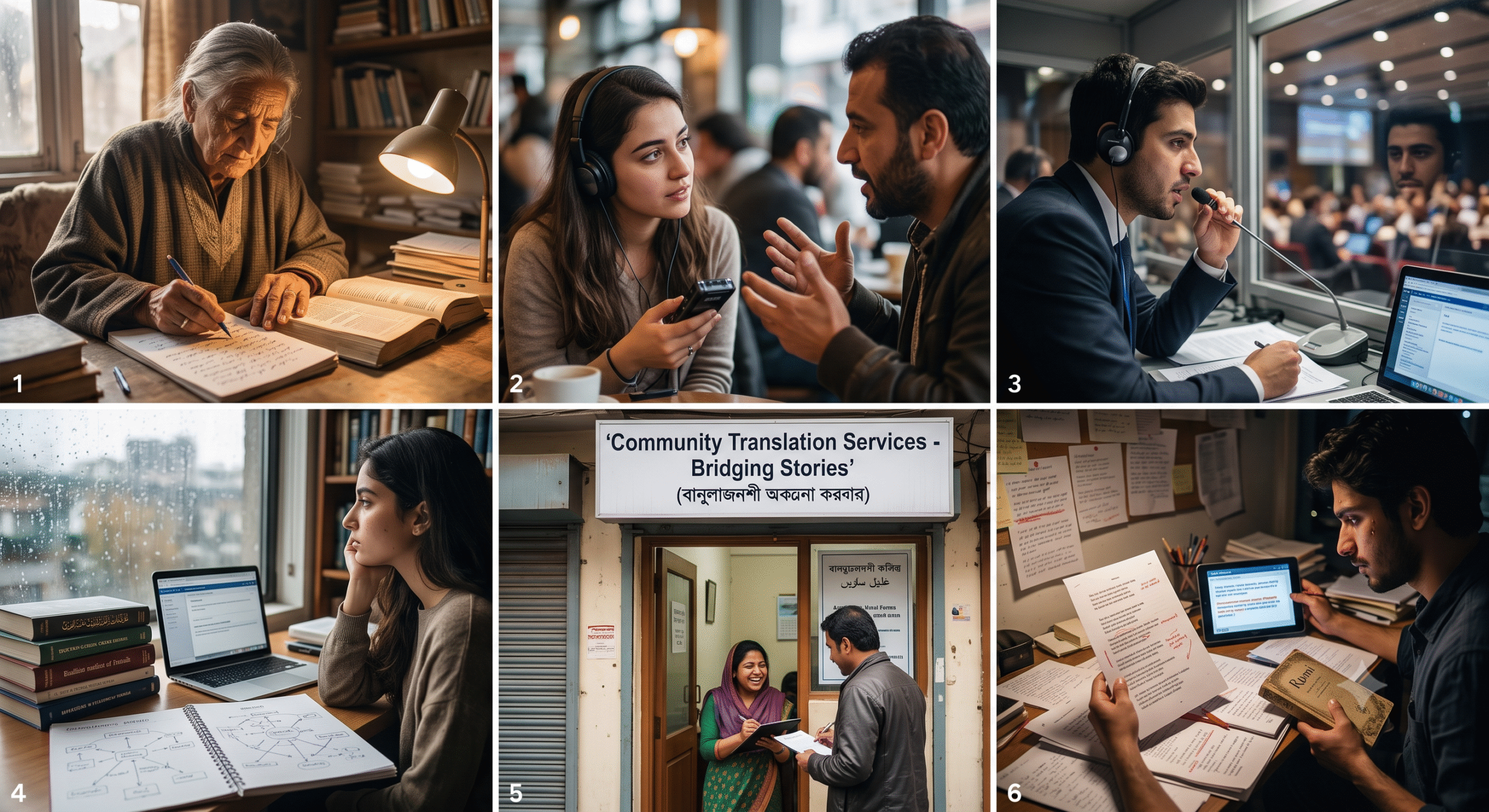
Language is more than grammar; it is the living memory of a civilization. Bridging two distinct worlds requires intellectual humility, creative instinct, and an ear for the untranslatable.
By Aubaid Ahmad Akhoon
In an increasingly interconnected world, translation has emerged as one of the indispensable pillars of human communication. Every day, people travel, study, conduct business, negotiate treaties, and interact across linguistic borders. Scientific discoveries, educational philosophies, literature, history, and ancient traditions can reach a global audience only when they are made accessible beyond the mother tongue in which they were first conceived. Yet, despite its civilizational importance, translation is still widely misunderstood as a mechanical exercise—a simple clerical routine of swapping words from one language with their dictionary equivalents in another. In truth, translation is an intellectual craft and an art form. It is the delicate, deliberate process of carrying meaning, thought, emotion, cultural nuance, and stylistic register from one linguistic sphere into another without compromising the vital spirit of the original text.
In an era dominated by artificial intelligence, this distinction has grown sharper and more urgent. Modern neural networks and algorithmic tools can process a sentence, a legal brief, or an entire manuscript in a matter of seconds. Digital platforms and social feeds are saturated with automated translations, synthetic voiceovers, and computer-generated prose. At first glance, this technical feat makes cross-lingual communication look frictionless. But anyone who works seriously with language knows that authentic translation involves complexities no algorithm can solve with the push of a button.
A living language is never a mere catalog of terms and rigid syntax rules. It carries the collective memory, historical traumas, spiritual traditions, and lived experiences of the community that speaks it. Every tongue possesses its own cadence, rhythmic pauses, layered metaphors, subtle irony, and inherited idioms. Translating a poet, a novelist, or an essayist is therefore an exceptionally demanding task. Transporting an author’s inner world—their psychological nuances, aesthetic sensitivities, and emotional temperaments—into an entirely different linguistic framework is far from straightforward. It demands rigorous technical training, deep cultural literacy, literary sensibility, and an instinctive command of the target language. A poet may evoke grief through an image rooted in local folklore; a novelist might use a regional vernacular to expose a character’s hidden vanity; an essayist might rely on an idiom whose resonance evaporates if rendered literally. The translator must decipher every underlying layer before setting pen to paper.
Every language harbors expressions whose roots run so deep that no direct counterpart exists. Sometimes, the limits of translatability point toward the profound mysteries of human comprehension itself. A striking illustration can be found in the Huruf Muqatta’at—the disjointed, enigmatic Arabic letters that open several chapters of the Holy Qur’an, such as Alif-Lam-Mim, Ya-Sin, Ta-Ha, and Ha-Mim. Their precise, definitive meanings remain shielded from absolute human certainty. Classical commentators and modern scholars have offered myriad theological interpretations while humbly acknowledging that ultimate knowledge of their divine intent rests with the Creator alone. Such instances remind us that translation is not always about matching signifiers across lexicons. Sometimes, the difficulty lies in the fundamental nature of the original utterance. When the definitive meaning of a phrase transcends human certainty, no translator can claim to reproduce it without loss or speculation. The lesson here is intellectual humility: an accomplished translator must know what can be rendered directly, what must be interpreted with context, and what must be preserved in its native, untranslatable aura. When a single word embodies generations of communal memory, it may demand an entire descriptive phrase. The translator’s duty is to construct that bridge without diluting the original prose’s aesthetic weight or emotional momentum. To mechanically swap word for word is merely substitution; true translation demands equivalence of resonance, substance, and impact.
This is why verbatim translation frequently fails. A lexicon provides literal definitions, but human context dictates real-world meaning. Rendered word for word, a vibrant colloquialism turns into nonsense, a startling metaphor collapses into absurdity, and an intimate sentiment becomes cold and sterile. The skilled translator does not ask, “What is the mechanical equivalent of this word?” Instead, they ask: “What did the author intend to make the reader feel? What cultural weight rests beneath this phrasing? How would a native speaker express this exact psychological reality with natural elegance?” Here lies the demarcation between automated processing and literary craft.
The limitations of machine processing become starkly apparent in the realm of regional languages, regional dialects, and oral cadences. On social media platforms like Instagram and YouTube, users regularly encounter videos narrated by artificial intelligence attempting regional accents, such as Kashmiri-accented English or Urdu. While the computational speed may appear striking to an outsider, native speakers instantly identify the flaws. The intonation is flat, the phonemic stress is misplaced, the vowel lengths are skewed, and the overall cadence feels hollow. To those who grew up with the language, the result often sounds awkward, robotic, or unintentionally comical. The breakdown is not simply a matter of vocabulary; it is a failure to capture how speech lives inside a human throat and chest. Speech is governed by instinct, micro-pauses, breath control, and communal habit. A server farm can index grammar rules, but it cannot inherit the oral heritage that shapes a mother tongue. Language is not merely produced by vocal cords; it is lived through physical community, geography, and memory.
These stakes rise dramatically when handling creative literature. To translate an adib, a poet, or an afsana-nigar is to enter another human being’s imaginative sanctuary. The translator must understand not merely the sentences on the page, but the silences between them. One must carry across the writer’s imagery, symbolic motifs, underlying irony, and aesthetic voice. This undertaking requires mastery of the source language paired with an inventive, disciplined mastery of the receiving tongue. A linguist who possesses bilingual fluency without artistic sensitivity will produce a document that is grammatically correct yet dead as literature.
During my Master’s studies in Urdu, our curriculum featured a comprehensive volume dedicated entirely to The Art of Translation. Treating translation as a standalone intellectual discipline was an illuminating lesson in itself. It proved that fluency alone does not qualify someone as an effective translator. The craft demands theoretical grounding, practical discipline, comparative analysis, and refined critical taste. This rigorous outlook has deep historical roots. In the early nineteenth century, institutions like Fort William College in Calcutta treated translation as a formal, civilizational enterprise. Their scholars recognized that modern prose traditions and intercultural knowledge transfers required rigorous intellects, cultural diplomacy, and deep linguistic dedication.
Translation is an irreplaceable bridge between distinct civilizations. Literature offers an intimate window into the griefs, triumphs, and internal dialogues of societies continents away. Through sensitive translation, an ordinary reader encounters the philosophy, folklore, and collective consciousness of distant peoples without having to master their languages. The translator performs an essential service: moving human empathy and intellectual wealth across borders.
Artificial intelligence undoubtedly offers practical advantages. It accelerates basic research, suggests alternative phrasing, parses syntax, and generates rough working drafts. For students, scholars, and working professionals, it serves as a competent computational assistant. The danger arises when institutions mistake rapid computational output for literary comprehension. An automated translation may run smoothly on the surface while entirely missing cultural irony, flattening poetic imagery, or garbling local idioms. Software processes datasets; human beings interpret lived realities. Interpretation requires lived experience, ethical responsibility, and artistic discernment.
A conscientious translator understands when to follow syntax closely and when to depart from it in pursuit of tonal fidelity; when to retain a cultural reference as a loanword and when to recreate its effect through analogy. The ultimate benchmark of any translation is not structural mimicry, but whether the rendered piece creates an equivalent cognitive and emotional shock in the new reader. When a translation succeeds completely, it becomes an invisible art: the prose breathes so naturally that the reader forgets it was ever composed in another tongue. In the decades ahead, as automated text saturates our media landscape, society must guard against the erosion of this discernment. The real crisis is not that machines will translate human languages, but that human beings will forget the emotional resonance that gives language its soul.
Disclaimer: The views expressed in this feature article are solely those of the author and do not necessarily reflect the official editorial stance or opinions of this publication.
Leave a Reply